"The world doesn't punish the cruel — it punishes those who believe everyone plays fair."
When I first read War and Peace (Leo Tolstoy), I read it as a school assignment, mostly just to tick another book off the list. But a few years later, as I started digging deeper into the "adult world," studying macroeconomics, wars, human behavior, and history in general, I decided to read it again. The book, of course, hadn't changed — but I had. In light of this article, one exchange between Prince Andrei Bolkonsky and Pierre Bezukhov keeps echoing in the back of my mind:
Pierre: "But isn't it true that all people want peace and happiness?"
Prince Andrei: "No, Pierre. People don't want peace. They want power. In our reality, naivety like yours — believing in a universal desire for peace — leads to tragedy. Those who think everyone wants peace are the first to suffer."
In 2015, Europe saw the start of its first migrant wave, in which millions of people fled their home countries, most of them from the Middle East and Africa. And yes, someone will say: "But isn't it only human to take everyone in and give them a home?"
Well… not quite. Here's why. If you want to spark a conflict anywhere in the world, there's really only one thing you need to do: mix populations together. Put two groups of people in the same area who differ by religion, skin color, or even just language, and history shows the probability of conflict rises exponentially. In fact, you don't need to look far back in time or far away geographically — just think of the Balkans in the 1990s.
Setting aside for a moment the people who fled for genuinely sincere reasons (which is most of them), let's look at the situation a bit more deeply. Is it possible that someone, deliberately and systematically, set out to unravel Europe more than a decade ago?
Many people wonder why there are so many migrants in their country. Well, let's put it very simply. If a central bank prints enormous amounts of money, it makes its population wealthier — or more precisely, when there's more money in the economy, it becomes easier to get your hands on it. When it's easier to get money, the appetite for hard, physical labor drops. And when there's no appetite for hard labor, who's going to keep industry running? This is where we get to the heart of the problem. Loose monetary policy made the domestic population somewhat wealthier — more precisely, it made it easier for the domestic population to earn a living. But then who works in the factory? Who cleans the streets? Who builds the buildings?
Yes, your answer is correct — migrants.
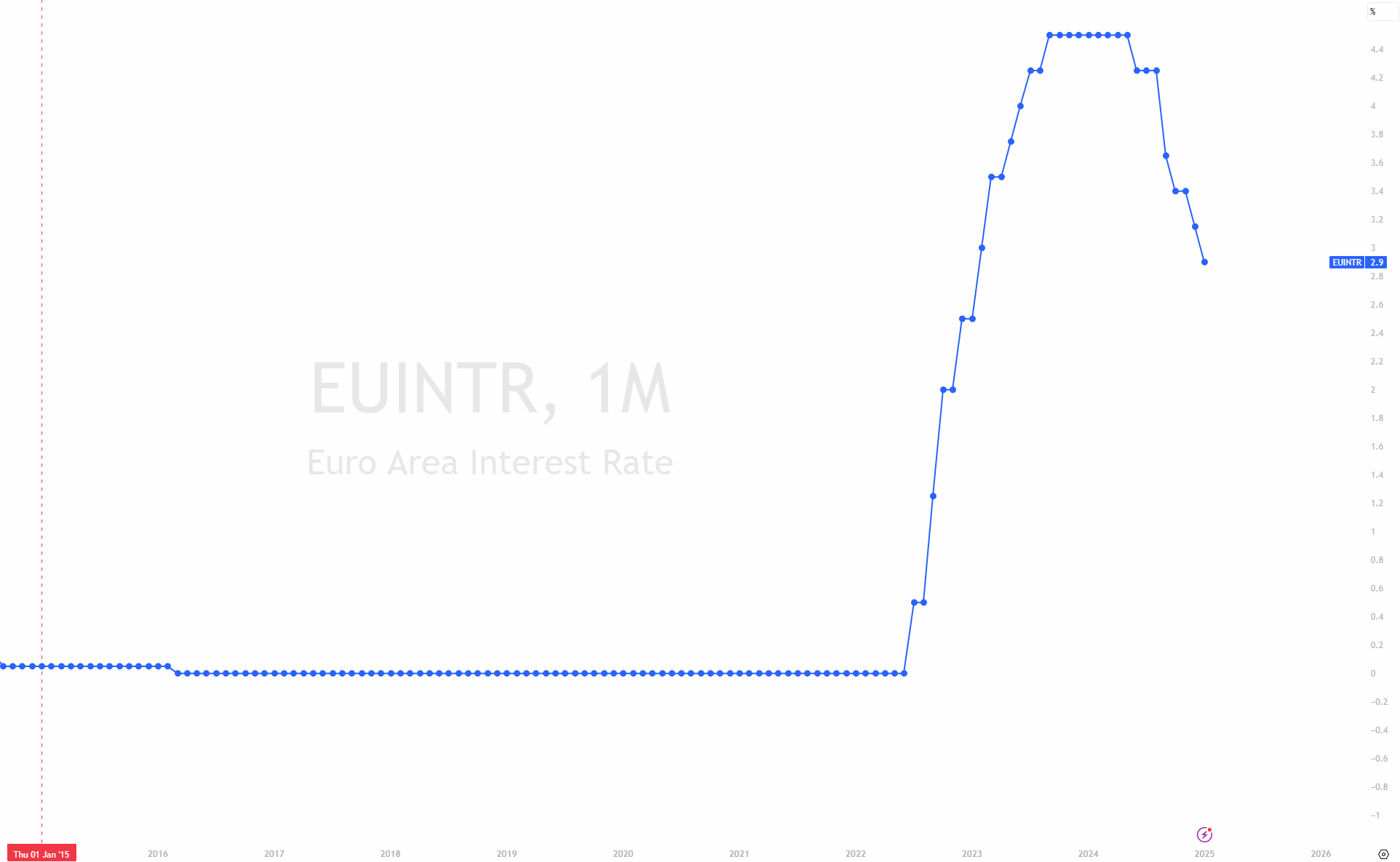
Low interest rates drove greater migration into Europe.
While this temporarily plugged the hole in the leaking barrel, the problem was only postponed, not solved. Remember, excessive mixing of populations increases the grounds for conflict, and it also directly drives political change — this time toward the right (something we're seeing something similar to in the U.S. with Donald Trump's decisive victory).
But let's step away from population dynamics and shift to geopolitics.
Since Russia's invasion of Ukraine, tectonic shifts have been playing out across Europe. Sweden ends 200 years of neutrality and joins NATO. The Nord Stream pipeline mysteriously explodes — a move that primarily benefits the U.S. while eliminating Russia's ability to use gas as a lever of pressure. Russia loses $25 billion due to the ensuing sanctions, then retaliates by shutting off gas entirely, wiping out $1.5 trillion in European market value.
Let's return once more to 2015 and the theory that someone is deliberately targeting Europe for destruction. This move also fits that pattern. Conflict on European soil, combined with energy market turmoil, looks like a calculated reaction from someone who understands energy markets and levers of power with clinical precision. The ultimate irony? Europe is essentially financing its own downfall — buying Russian energy in order to fund military aid to Ukraine. It's like paying someone to punch you in the face. And it doesn't stop there — Europe's own naivety punishes it yet again. Having imposed tariffs on Russia and cut off trade under political pressure, who is it supposed to buy energy from now? Energy that's critical to Europe thanks to Angela Merkel and her transition to cheap Russian gas. Only two options remain:
1. More expensive American energy.
2. Russian energy imported through third countries (also more expensive).
Yes, Europe has shot itself in the foot.
Euro-xit and Russia
Britain has already left Europe. Germany's industrial model is collapsing. What's left? Tourism? Even that is under threat from rising crime and social instability. And tourism is supposed to make up around 5% of GDP — it isn't meant to carry the economy of entire nations.
To understand how Putin turned Europe's strengths into weaknesses, we need to start with an astonishing ratio: 1.9 trillion euros of German manufacturing output rests on just 27 billion euros of Russian energy inputs. Putin identified this pressure point and decided to exploit it. German industry has now posted flat or falling GDP for two years running — in other words, no growth whatsoever (the definition of a recession is three consecutive QUARTERS of decline).
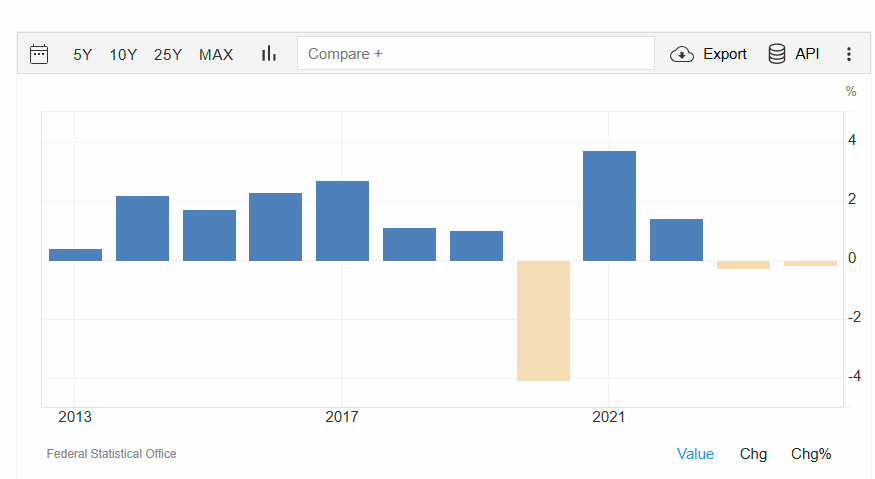
German GDP has shown no growth for two years.
Germany's industrial strength rested on three pillars: cheap Russian energy, cheap labor, and near-guaranteed exports to China. In the last few years, Germany has lost one of these pillars outright, while the other two are on shaky ground. Russian gas is a thing of the past, while within the population, absurd welfare models are discouraging work. On top of that, in much of the EU countries that took in migrants on a mass scale, protests and unrest are now emerging, further reducing labor participation. The third pillar, exports to China, is also wobbling as the Chinese economy slows.
The monetary trap — the problem of a shared currency
Germany is becoming more of a financial hub than an industrial one. That adds a new problem to European monetary policy. If Europe becomes more services-oriented, it will have less reason to keep the euro weak — the very thing that helped its exporters dominate global markets. But that won't help the countries that also use the euro and want a strong industrial base. The euro could shift from being a tool that boosts exports to being bait for investment instead.
The ECB now faces an impossible choice:
- Protect the currency — raise interest rates, which would kill industry and growth.
- Protect the economy — print money, which would destroy the euro but boost industry and exports.
How will this end?
Europe's naivety is unfortunately coming home to roost. Pushing left-wing politics and a society where everything is treated as normal except being normal (LGBTQ, endless gender categories, and other such ailments), accepting populations from around the world without proper assimilation, relying on Russian energy, and so on — all of this will finish off the current order in the EU.
On the monetary side, two scenarios are possible:
- Acceptance — accepting lower growth, which will over time lead to a lower standard of living.
- Currency crisis — the ECB fails to balance its monetary policy, leading to a collapse of the euro.
Europe will soon learn its lesson — the hard way. The question is no longer whether a downturn is coming, but whether that downturn will become the trigger for a broader reform of the global monetary system. Putin may have found the lever that breaks Europe from the outside, but Europe has managed to destroy itself through its own naivety, and through partners who were not — and still are not — honest, no matter what the people running Europe would like to believe.