J. Pierpont Morgan, perhaps the greatest financial mind America has ever produced, once said:
“Gold is money. Everything else is credit.”And how right he was.
During the American Civil War, the U.S. money supply began its fateful shift from being backed by gold to being backed by debt. That shift culminated in Nixon's disastrous decision to end the dollar's gold standard. Today, the paper we call money isn't even backed by debt anymore – it is debt.
And like any debt, it isn't safe. Its value rises and falls with the probability of repayment. What has become clear over the past four years is that this debt will not be repaid – at least not at the value everyone once assumed.
Consider this: if you had kept a dollar or a euro in your pocket over the past three and a half years, it would have lost 20% of its value. Today, it can buy only 80% of what it could when you first put it in your pocket.
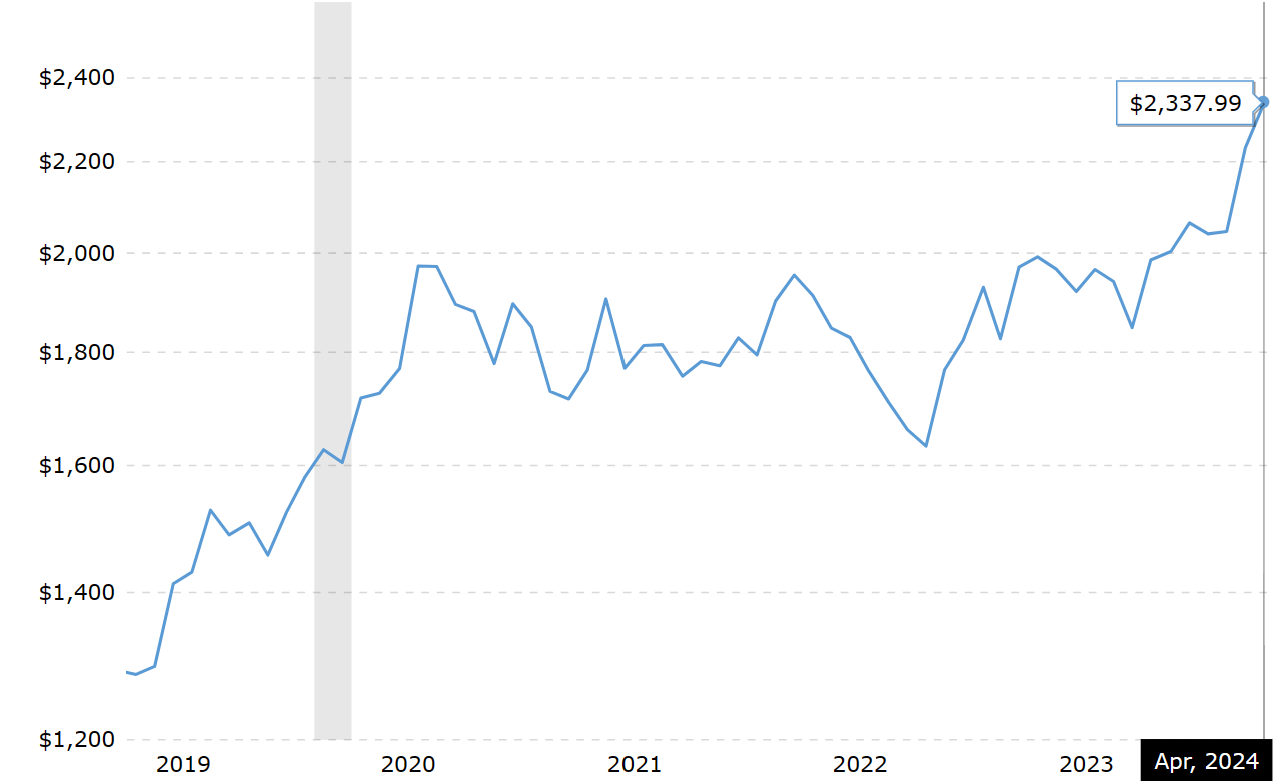
And gold? The “barbarous relic,” as Keynes called it, has jumped 51% since the start of 2020. That raises two questions: What's driving this rally, and where does gold go from here?
Many dismiss gold's rise as unrelated to inflation because the two don't line up perfectly. In other words, the drop in the dollar's purchasing power doesn't fully track the rise in gold's price expressed in those same dollars.
But that's not entirely accurate. Because of the speculation surrounding gold and the possibility of its return to a role in the monetary system, gold carries more volatility than a typical precious metal (silver, for example). Over the long run, however, gold's price measured in dollars is an extremely informative gauge of the dollar's value.
Since the dollar's last remaining link to gold was severed on that fateful Sunday, August 15, 1971, gold has risen 6,000%. In other words, the dollar has lost 98% of its value.
In reality, the dollar had been losing value for half a century before that loss was clearly reflected in the price of gold. The Federal Reserve and the Treasury manipulated foreign transactions and rigged international markets to artificially prop up the dollar's value.
The promise that dollars could be exchanged for gold was a lie told to keep the illusion alive.
To understand the dollar's true value today, you have to go all the way back to the Great Depression, when President Roosevelt fixed gold at $35 an ounce, and compare the dollar's purchasing power then with its purchasing power now.
Naturally, the dollar has since lost 98% of its value, measured against what a typical city consumer buys. That figure is also a precise measure of the dollar's devaluation against the cost of gold.
So while gold behaves like a speculative commodity in the short term, over the long term it is a hedge against inflation.
As I noted back in late 2023 in the article "What to Expect from Gold in 2024," gold had every parameter in place for a new leg up. The reasoning was simple: gold hadn't moved much from its peak in late summer 2020, yet the dollar had lost 20% of its value since then.
Gold was primed for a new advance, and it has since moved nearly 20%!
The answer to the first question (what triggered gold's recent rally?) is simple: gold's inescapable nature as an inflation hedge is finally being priced in by the market. As dollars lose value over time, it takes more of them to buy the same amount of gold.
That brings us to the second question: where does gold go from here? Wall Street forecasts vary widely on this question.
Here's my take:
Gold's rise is entirely a function of inflation, or dollar devaluation. The main source of that inflation is the federal government's budget deficit, which will likely exceed $2 trillion this fiscal year. The economic outlook suggests that deficit will keep growing without limit. Spending restraint is unlikely under either a Republican or a Democratic administration next year, and restrictive monetary policy is just as unlikely. Based on the annualized monthly inflation rates since June 2022, it's likely that 3.0% annual inflation, or higher, will become the new normal. Once it becomes clear to the monetary authorities that even that isn't enough, the next leg up in gold arrives.
The gold price will keep rising until it catches up with the dollar's long-term depreciation. That's likely to happen in the second half of this year, around $2,500 an ounce.
After that, I expect gold to hold firmly above $2,000 an ounce, fluctuating as fresh upside surprises in inflation data push the Fed toward more aggressive policy, creating pullbacks within the broader macro uptrend in gold against the dollar.
Of course, none of this is financial advice – just an explanation of the real reason behind this precious metal's rise.