Cryptocurrencies like bitcoin tend to get associated with arms deals and other illicit activity, but they still represent an attempt to redesign the international monetary system on more equal terms. They hand power back to individuals and offer a digital analogue to gold.
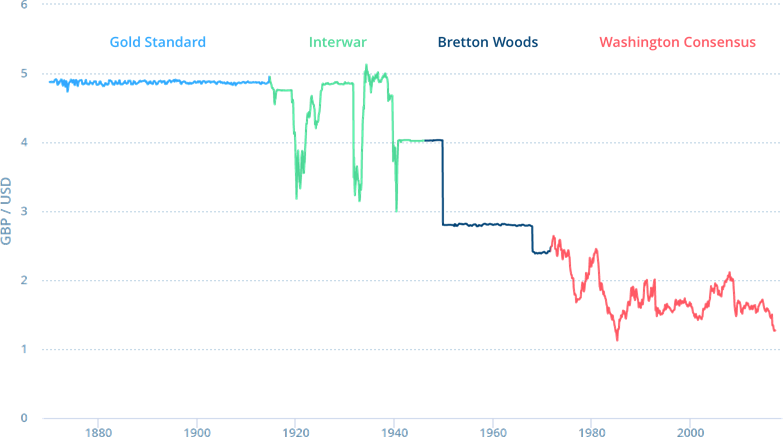
Figure 1. Perhaps the best way to understand the evolution of the international monetary system is to look at a specific currency pair such as GBP/USD. Exchange rates were stable for decades under the gold standard, but became unstable during the interwar period, when Britain reinstated and then abandoned the gold standard. There were another two decades of stability under Bretton Woods (albeit with two sharp devaluations), followed by volatility after the Nixon Shock of 1971.
The Modern Order
Before diving into the 19th-century history, let's briefly look at the current monetary order. The dollar has long remained the world's most important reserve currency. Most of the world's developed economies operate floating currencies or belong to the eurozone, while developing-world currencies are pegged either to the dollar (Asia, the Middle East, South America) or the euro (West and Central Africa).
The absence of a systemic anchor such as gold, and of any supranational fiscal authority, has let various nations (China chief among them) run chronic current-account surpluses, while others (the US chief among them) run chronic deficits. That has produced the odd situation in which some of the world's poorest countries effectively subsidize the lifestyles of the richest, allowing the latter to take on an enormous debt burden. But as the eurozone debt crisis demonstrated, imbalances like these are unhealthy and risk accelerating a financial breakdown. The Fed's massive monetary expansion following the 2007-2008 financial crisis added further risk, stoking fears of inflation and a falling dollar.
But what's to be done? No major change to the current status quo appears to be on the horizon. The fact that certain countries have managed to pile up trillions of dollars in debt without any obvious impact on their exchange rate suggests that classical economic models matter less than they once did. Even so, it's worth considering a range of possible alternatives to the dollar's prevailing hegemony – virtual currencies, multiple reserve currencies, and gold.
Special Drawing Rights (SDRs) are a form of world money controlled by the IMF, whose value is calculated using a basket of currencies. They were first introduced in 1969 to reduce the world's reliance on the dollar for international liquidity, but they remained largely sidelined until the recent financial crisis. Since then, countries have held a growing share of their reserves in SDRs and used them to settle their trade accounts. Their usefulness, however, is somewhat limited by the fact that individuals and corporations cannot use them, and that there are no liquid instruments denominated in SDRs.
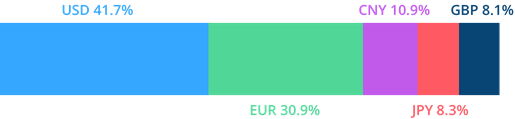
Figure 2. The current composition of the SDR.
Virtual currencies like bitcoin have also been championed as an alternative to the dollar. Launched in 2011, bitcoin was conceived as a digital analogue to gold: a universal money that anyone could own and spend anywhere. It was designed to be scarce – only 21 million will ever be in circulation – and hard to counterfeit, secured by unbreakable digital keys. Unlike traditional currencies, there was no central issuing authority – bitcoin was created and maintained by its own users, linked together by a software protocol. Growing commercial interest in the underlying blockchain methodology, together with rising demand out of China, made it the best-performing currency of 2016.
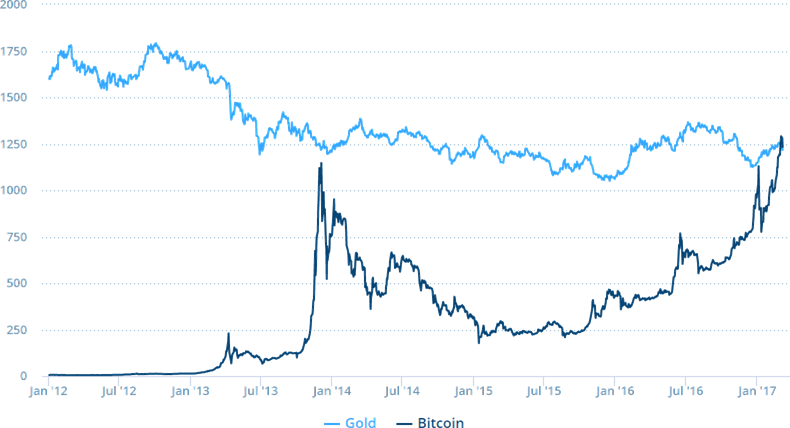
Figure 3. Bitcoin surpassed gold for the first time in 2017, amid a surge of interest in China, where it was used to facilitate capital flight out of the country.
A second scenario is the rise of multiple reserve currencies, with no single dominant one. Under this thesis, there would be a gradual shift away from King Dollar toward the euro, the ruble, and the yuan. There is precedent for this, such as the concurrent circulation of the pound and the dollar in the early 20th century, or the florin and the Venetian ducat in the 16th century. But there is no historical precedent for reserve currencies being used simultaneously without a single systemic anchor such as gold. Rather than only the Fed over-issuing its currency, several central banks would be tempted to do so at once, in which case there would be no safe-haven reserve currency left. What's more, regional currency blocs could easily grow into regional trade blocs, much like those that formed around the pound in the early 20th century: the so-called sterling area.
A more intriguing possibility is a return to gold – an idea that has found support at the very highest levels. Donald Trump tweeted his support for gold during his presidential campaign, and Alan Greenspan and former World Bank president Robert Zoellick have made similar arguments. The Fed's enormous monetary expansion since the financial crisis, along with fears that debtor governments might try to inflate away their obligations, has led some to look back fondly on the gold standard or a gold-exchange standard like the one established at Bretton Woods. So let's examine each of these two systems in turn.
The Classical Gold Standard (1870-1914)
Until the 1870s, most monetary systems were built on a bimetallic standard. Britain was the only country on a gold standard, after Sir Isaac Newton, in his capacity as Master of the Mint, set the wrong gold-to-silver price ratio in 1717 and effectively drove silver out of circulation. But by 1870, Britain had become the world's leading commercial power, giving its trading partners an incentive to adopt its monometallic standard as well. After Germany moved to gold in 1871, and the US in 1873, the bulk of the world's industrial nations followed suit, so that by 1900, only China and a handful of Central American countries remained on silver.
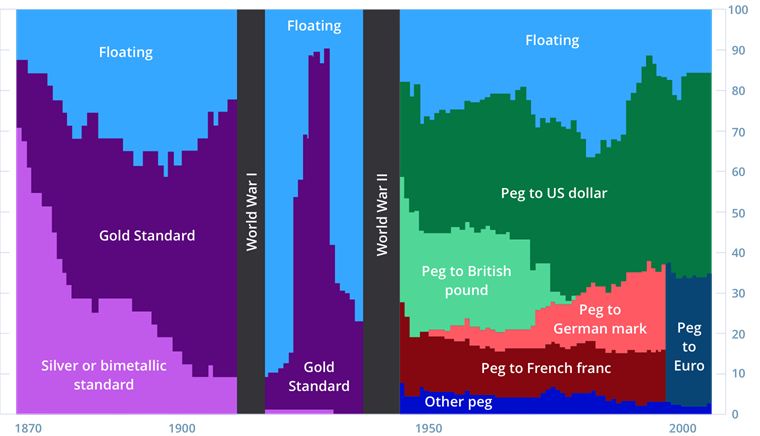
Figure 4. Types of monetary regimes through history. Source: Eric Tymoigne/Twitter – Feenstra and Taylor (2011), based on Meissner and Oomes (2009).
The gold standard delivered stable exchange rates by fixing currencies against gold. Central banks stood ready to convert paper currency into a set quantity of gold. One consequence was that countries could not run persistent trade imbalances. When a country ran a trade deficit, it experienced an outflow of gold, which set off a self-correcting chain of events known as the price-specie-flow mechanism. With less gold-backed money circulating domestically, prices fell in the deficit country, making imports more expensive and exports cheaper, thereby eliminating the deficit. In practice, however, external adjustment usually took place without any significant movement of gold at all. When a country ran a deficit, its central bank could intervene to speed up the adjustment of the money supply by adjusting its discount rate. If the bank raised that rate to make credit more expensive, fewer intermediaries would be willing to submit bills for discount in exchange for cash from the central bank. That would shrink the volume of domestic credit and restore balance-of-payments equilibrium without any need for gold to actually flow.
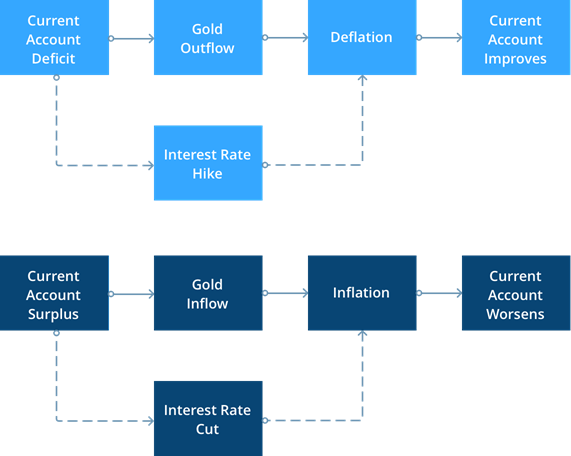
Figure 5. The mechanism by which the gold standard eliminated trade imbalances.
The linchpin of the classical gold standard was the priority governments placed on maintaining convertibility. Political pressure to subordinate currency stability to other goals, such as growth and full employment, was not a feature of the pre-1914 world – wages and prices were flexible, letting a balance-of-payments shock be absorbed through falling costs and wages. Investors were well aware of these priorities, so they had little fear of devaluation before 1914, and when currency fluctuations did occur, investors reacted in a stabilizing way. Whenever the exchange rate fell to the point where gold arbitrage became profitable, funds would flow in from abroad, anticipating the profits domestic-asset investors would earn once the central bank intervened to strengthen the exchange rate.
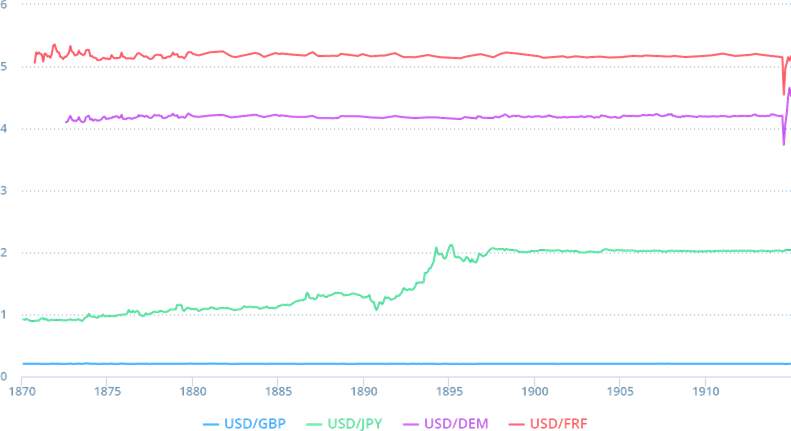
Figure 6. The pound, yen, German mark, and French franc against the dollar.
The gold standard offered two major advantages. First, it delivered long-run price stability, since it bound governments to a time-consistent monetary and fiscal policy. Governments could not adjust their money supply on a whim without suffering draining outflows of gold. Second, the gold-standard era was marked by low interest rates, since bond markets viewed the gold standard as a “good housekeeping seal of approval.” Currencies pegged to gold were unlikely to be devalued, and their governments were unlikely to pursue reckless fiscal policy, so it was relatively safe to lend and invest money in countries that were on gold. For these reasons, the gold standard was associated with a spectacular expansion of world trade.
But it wasn't all rosy either. Because monetary authorities were committed to maintaining stable exchange rates, they couldn't pay much attention to unemployment and growth. What's more, tying the international monetary system to a scarce metal placed a real ceiling on credit growth. Indeed, the gold standard frequently produced deflation, since world growth often outpaced the availability of gold for monetary purposes. This was especially true before the invention of the cyanide extraction process and the major gold discoveries in the Klondike and South Africa in the late 1890s. Agricultural commodities like wheat saw a secular decline in prices throughout the gold-standard era, causing severe hardship for farmers. Another drawback was that the gold standard was remarkably efficient at transmitting crises around the world, thanks to the price-specie-flow mechanism mentioned above. The panics of 1857, 1973, 1907, and 1929 all originated in the US, but ultimately dragged much of the rest of the world down with them.
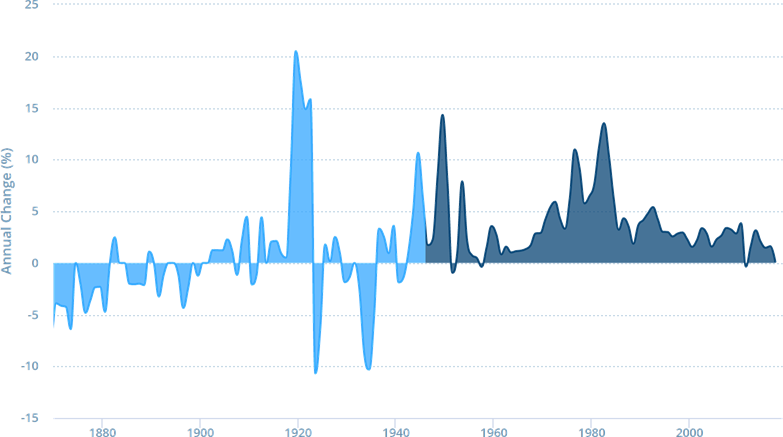
Figure 7. The US gold-standard era is marked by the light blue area; Bretton Woods is marked by the dark blue area. Notice how deflation was far more prevalent under the gold standard than afterward.
The Collapse of the Gold Standard (1914-1930)
The classical gold standard came to an abrupt halt in 1914 with the outbreak of the First World War. Private trade and the export of gold were suspended, and individual countries began financing their war debts by issuing bonds and printing money, producing widely diverging inflation rates. After the war, the major powers tried to restore the gold standard, but with disastrous results. Britain's decision to return to gold at its pre-war parity in 1925, driven by a sense of duty toward British creditors, left the pound overvalued by 10% against the dollar because of the inflation gap that had opened up since 1914.
In 1931, Britain abandoned the gold standard once again, and most other countries soon followed, which brought an immediate return to growth. The US held onto gold, although in 1933 it devalued the dollar price of gold from $20/oz to $35/oz. These measures freed the world's currencies from their golden shackles, but the damage had already been done – the failure to adjust to the downturn following the 1929 Wall Street crash fueled the rise of protectionism and trade blocs, to the detriment of world trade and growth.
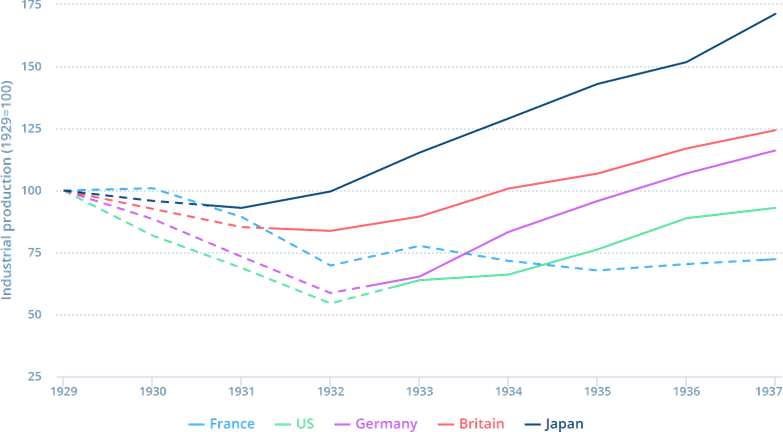
Figure 8. Most industrial countries returned to growth after abandoning the gold standard (where the dashed lines turn solid).
Bretton Woods (1945-1971)
A new monetary order emerged from the Bretton Woods agreement at the end of the Second World War, designed to stop nations from engaging in the currency and trade wars that had so badly damaged the world economy in the 1930s. It included the creation of the International Monetary Fund, the World Bank, the General Agreement on Tariffs and Trade (the WTO's predecessor), and an international gold-exchange standard.
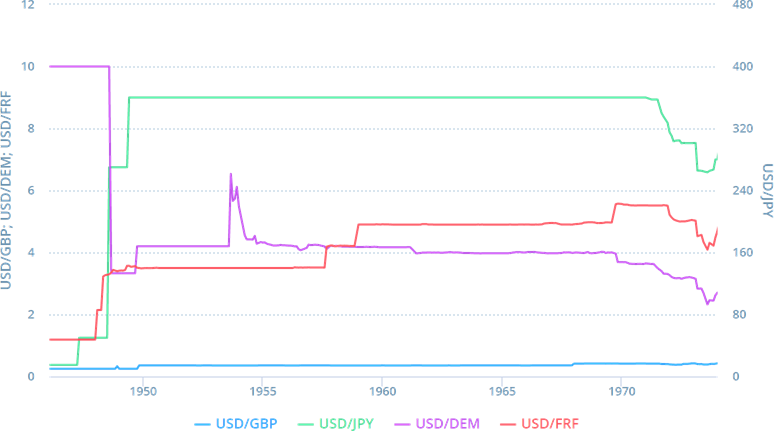
Figure 9. The pound, yen, German mark, and French franc against the dollar
Under Bretton Woods, countries pegged their currencies to the dollar at set parities, which was in turn convertible into gold at the official rate of $35/oz. That convertibility, however, applied only to dollars held by central banks and governments, not private citizens. The US was responsible for maintaining price stability but did not engage in currency intervention itself – other countries had to intervene to fix their own exchange rates against the dollar. The intent was that these pegs could be adjusted in the event of a “fundamental disequilibrium,” and they were accompanied by strict capital controls designed to prevent speculative attacks and give central banks a minimal degree of policy independence. In the event of any balance-of-payments trouble, the IMF stood ready to extend loans to the affected countries. In short, the system was meant to combine flexibility with stability, overcoming the shortcomings of the classical gold standard.
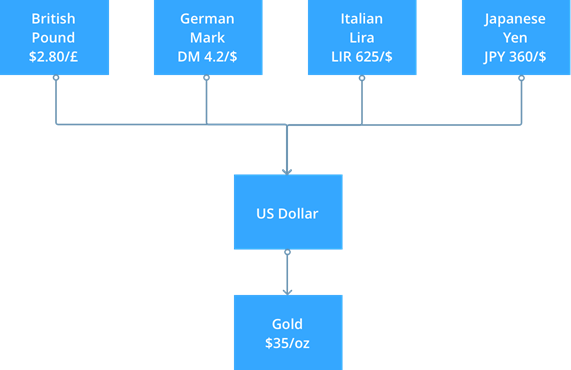
Figure 10. Bretton Woods exchange-rate pegs.
Opinions on Bretton Woods remain divided. For some, it was a key ingredient of the postwar golden age of growth, delivering exchange-rate stability in stark contrast to the volatility that preceded and followed it. It solved payments problems, enabling the phenomenal expansion of international trade and investment that fueled the world boom of the 1950s and 1960s. Others argue that Bretton Woods was a consequence, not a cause, of postwar growth, and that it suffered from a series of structural weaknesses that sealed its fate from the very start. It's a wonder, they argue, that it survived as long as it did. So what were those weaknesses?
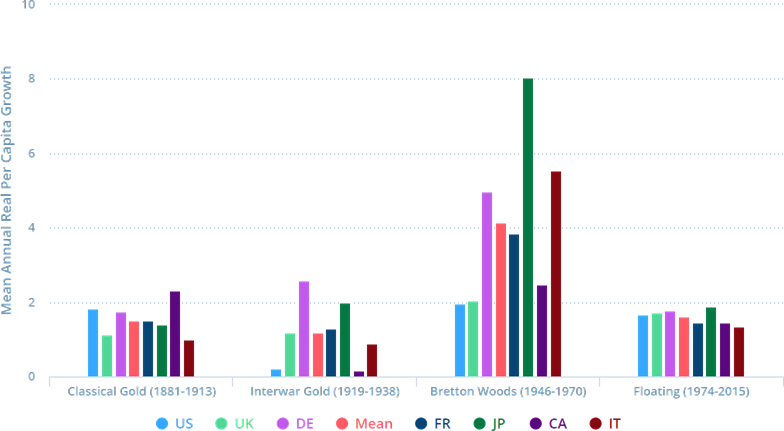
Figure 11. Real per-capita growth by monetary regime, G7.
First, there was no automatic mechanism for resolving current-account imbalances. Unlike under the gold standard, European countries could no longer address balance-of-payments problems by adjusting interest rates or domestic prices. Governments were no longer willing to subordinate growth and full employment to exchange-rate stability. Exchange controls and import restrictions, of the kind European countries used in the early years of Bretton Woods, stopped being a viable option once current-account convertibility was restored in 1958 and the eurodollar market developed through the 1960s. That left parity adjustments as the only remaining way to remove imbalances, something nations refused to do for fear of the embarrassment involved – parity adjustments were a highly visible mark of failure.
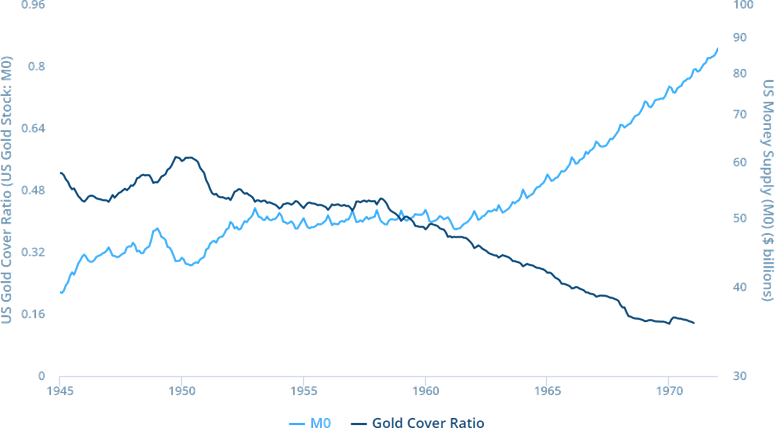
Figure 12. The ratio of dollars to gold held by the Federal Reserve fell through the 1960s, raising concerns about their supposed convertibility.
Second, the dollar's central role in the system created a set of problems all its own. It was only natural for central banks to supplement their gold reserves with dollars, given the US's dominant position in trade and finance and its vast gold holdings. But that also allowed the US to run chronic trade deficits, letting Americans live beyond their means and put off any effort to strengthen their current account. Many nations bristled at this ‘exorbitant privilege,’ and De Gaulle even threatened to liquidate France's dollar holdings. A related problem was the Triffin dilemma. Confidence in the dollar rested on the perception that the US would convert it into gold. Therein lay the paradox: world trade depended on a steady supply of dollars, but supplying those dollars undermined the credibility of the US's ability to convert them all into gold. This became a genuine problem after 1960, when the world's dollar holdings exceeded US gold reserves at the official rate of $35/oz.
Third, Bretton Woods relied heavily on foreign support for the dollar. International cooperation was achievable in the early years, when the dollar delivered price stability, but it became harder to sustain once the US began inflating in the 1960s to finance deficit spending on the Vietnam War and Lyndon Johnson's Great Society initiatives. Inflation-averse countries like Germany had little appetite for importing American inflation. The London Gold Pool illustrates just how necessary international cooperation was. In 1961, a number of European central banks pledged not to convert their dollars and sold gold from their own reserves to relieve speculative pressure on the dollar. But once it became clear that the US would not subordinate its economic and political goals to defending the dollar price of gold, the Pool collapsed in 1968 under heavy speculative pressure. To keep the Fed from running out of gold entirely, a two-tier gold market was established, under which private gold prices were allowed to rise while the official transaction price stayed fixed. When the private-market price immediately jumped to $40, foreign central banks had a powerful incentive to cash in their dollars at the original $35/oz rate.
The Collapse of Bretton Woods (1971-73)
Eventually, in the spring of 1971, a major shift out of dollars and into the German mark forced Germany to suspend intervention and let the mark appreciate. Once the dollar exodus began, it could not be contained, and by mid-August it was announced that France and Britain intended to convert their dollars into gold. On August 13, President Nixon closed the Fed's gold window, suspending the obligation to supply gold to foreign central banks at $35/oz or any other rate. He also imposed a 10% surcharge on imports to force other countries into revaluing their currencies, so as to avoid the embarrassment of an outright dollar devaluation. Together, these actions became known as the Nixon Shock.
Over the following four months, the world's major nations engaged in negotiations to reform the international monetary system, culminating in the Smithsonian Agreement in December. It was agreed that the dollar's devaluation would be capped at 8%, with the rest of the relative price adjustment coming from the revaluation of the yen, the Swiss franc, and the German mark. Bretton Woods' currency fluctuation bands were widened from 1% to 2.25%, and the US import surcharge was lifted, but the US was not obligated to reopen its gold standard. In reality, very little actually changed. American policy remained too expansionary to be consistent with pegging the dollar to foreign currencies, and having devalued once, there was no reason to assume the dollar wouldn't devalue again. A speculative attack on sterling forced Britain to float free of its band in 1972, followed by Switzerland in early 1973, and when the dollar devalued a further 10% against the major European currencies in February, the dollar exodus was forced to continue. Matters came to a head in March, when the German mark and other EEC currencies surged, delivering the final coup de grâce to Bretton Woods.
The Washington Consensus (1973-Present)
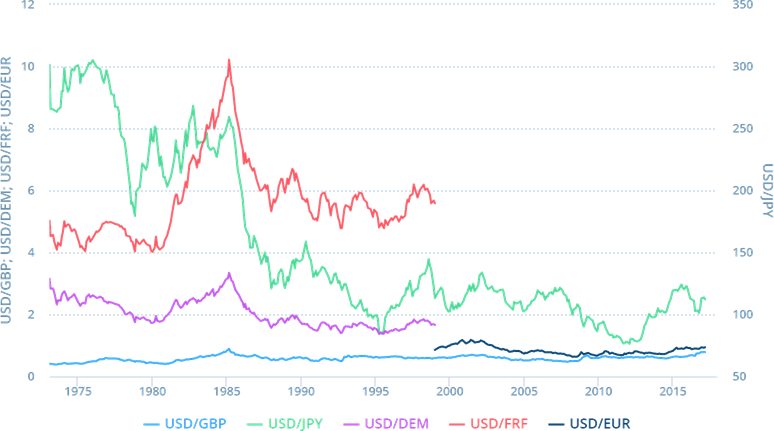
Figure 13. The pound, yen, German mark, French franc, and euro against the dollar.
After the collapse of the Smithsonian Agreement, the major currencies of North America, Europe, and Japan were left to float. Through the 1970s, the dollar depreciated modestly, before beginning its dramatic ascent following the Volcker Shock of 1979-80, when US interest rates were pushed to unprecedented levels. By 1985, the dollar's strength was hurting US competitiveness, prompting the US, Japan, Germany, and France to sign the Plaza Accord, under which they jointly intervened to push the dollar lower. Their intervention proved so effective that in 1987 they had to sign another agreement – the Louvre Accord – to halt the dollar's continued slide. Before these meetings, freely floating exchange rates were considered the ideal; afterward, the major economies began cooperating far more closely.
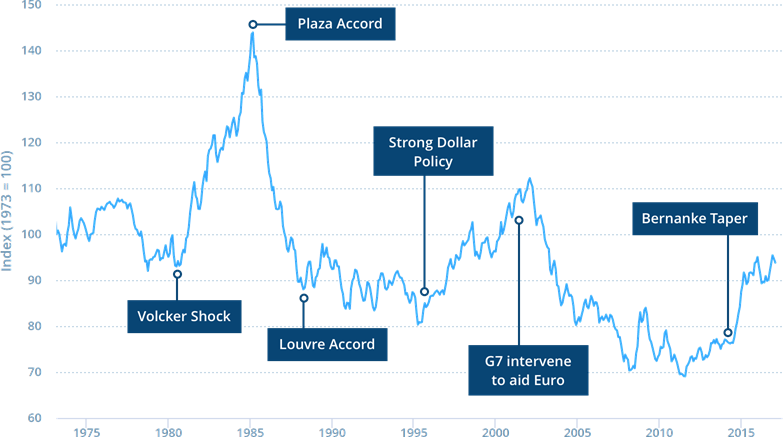
Figure 14. The US Dollar Index.
The core principles of the Plaza-Louvre framework, which still hold today, are:
Unannounced, soft target zones for the major currencies. Ordinarily, the market is left to determine exchange rates, but once rates move outside their target zones, joint intervention is meant to follow.
Interventions must be sterilized (i.e., central banks must absorb the inflows with bonds) so they don't affect the domestic money supply.
Capital mobility must be preserved.
The Evolution of the Euro (1972-Present)
Seeking exchange-rate stability after the Nixon Shock, Germany and several other European countries created a new system in 1972 known as the “Snake in the Tunnel,” under which their currencies traded within +/- 2.25% of one another and within a 4.5% band against the dollar. It failed to live up to expectations, however, plagued by frequent realignments and several wholesale withdrawals. At its core, it was a tug-of-war between Germany, which favored low inflation, and countries like France, which were keen to expand. In the absence of any overarching monetary or fiscal authority, strong-currency countries like Germany could never be sure that weak-currency countries would make the policy adjustments needed to maintain their peg, so they were reluctant to intervene on their behalf.
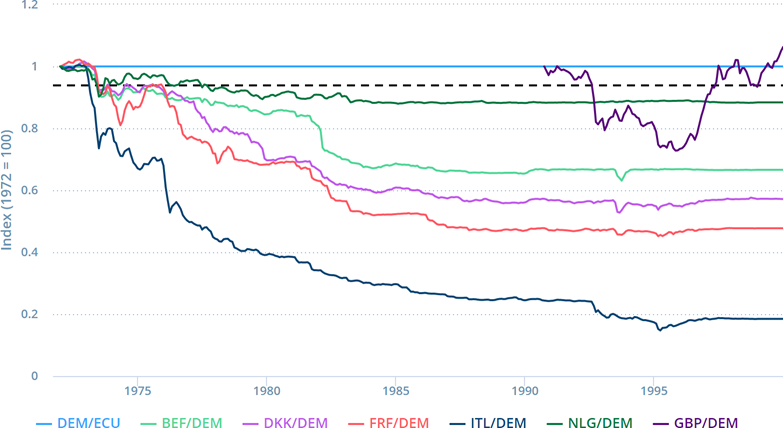
Figure 15. The Snake/EMS (1972-99).
The European Monetary System (EMS) was created by France and Germany in 1979 to address these shortcomings. Participating currencies still traded within their bilateral bands of +/- 2.25%, but these were now paired with capital controls to allow a degree of monetary-policy autonomy. More importantly, a new institution – the European Monetary Fund – was established to provide loans, known as ecus, to member states facing balance-of-payments difficulties. In practice, the EMS was a system built around the German mark, with German monetary policy serving as the nominal anchor – other countries brought their inflation down toward Germany's, which was the lowest in Europe. This time, none of the participants had to withdraw, and a far greater degree of exchange-rate stability was achieved, especially after 1985.
By 1991, EMS members were brimming with optimism. The EMS had proven resilient through the collapse of the USSR and German reunification. In that spirit, they committed to monetary union under the Maastricht Treaty, agreeing that by 1999 they would:
keep their currency within the EMS band for at least two years
have an inflation rate in the preceding year no more than 1.5 percentage points above that of the three lowest-inflation member states
bring public debt as a percentage of GDP and GDP growth down to 60% and 3% respectively
keep the nominal long-term interest rate in the preceding year within 2% of the three most price-stable members
Yet the very next year, the EMS faced its toughest test. In mid-September, Britain broke through its EMS limit and withdrew from the system in humiliating fashion, less than two years after joining. Italy also fell through its band and was forced to float, but somehow remained part of the system. Most other EMS currencies came under speculative pressure and were forced to realign. The crisis fundamentally stemmed from European governments' unwillingness to raise interest rates amid a severe recession, but speculative attacks, such as George Soros's raid on the pound, also played a role, generating self-fulfilling crises in otherwise solvent national economies.
After the crisis of the early 1990s, things improved – with monetary discipline spreading across Europe, austerity became easier to implement, and the absence of laggard countries like Britain removed a major brake on the system. EMS members locked in their exchange rates in 1999, and the euro was introduced in 2002. The euro delivered a number of benefits, including less disruption within European trade, improved price transparency, and a lower cost of capital for European companies. Still, there were several structural weaknesses that we're now well acquainted with. Adjusting to a single monetary policy was never going to be easy. Slow-growing economies like Italy preferred a looser European Central Bank (ECB) policy and a weaker euro, while fast-growing economies like Ireland preferred tighter policy to cool their overheating economies. What's more, interest rates for the “convergence economies” – EU jargon for poorer, peripheral economies like Greece and Portugal – suddenly fell to German levels. Spending and investment surged, and wages rose dramatically. After the boom, the convergence economies were left saddled with excessive wages, eroded competitiveness, and rising unemployment, which called for painful austerity measures.
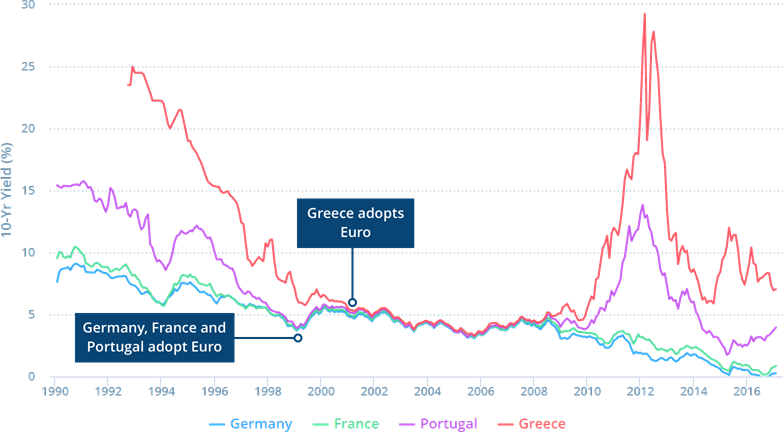
Figure 16. A selection of European long-term interest rates before and after the introduction of the euro.
Bretton Woods II (2000-Present)
At the turn of the millennium, a new system emerged, dubbed Bretton Woods II. A savings glut in the Middle East and the Far East combined with a savings drought in the US, producing a chronic US current-account deficit.
Since the late 1990s, China had been growing at a phenomenal rate, driven by investment exceeding 40% of GDP. National savings ran even higher, at 50% of GDP. Middle Eastern oil exporters and other ASEAN countries also ran excess savings. The US, meanwhile, was in the middle of the dot-com boom, with investment levels outstripping national savings. The gap between national investment and savings widened even further once President Bush's tax cuts reduced US government savings.
Accordingly, foreign governments parked their excess savings in US assets, mainly Treasuries. Both sides tolerated this arrangement, for their own separate reasons. Export-driven Asian economies like China wanted to build up dollar reserves to ease international payments and boost the competitiveness of their manufactured exports by keeping their currencies pegged against the dollar. The US, on the other hand, was able to service its debt more cheaply than it otherwise could have, and its residents were able to live beyond their means, courtesy of the developing world. These global imbalances came to be called Bretton Woods II, in a nod to the original Bretton Woods era, when Europe and Japan ran net surpluses against the US.
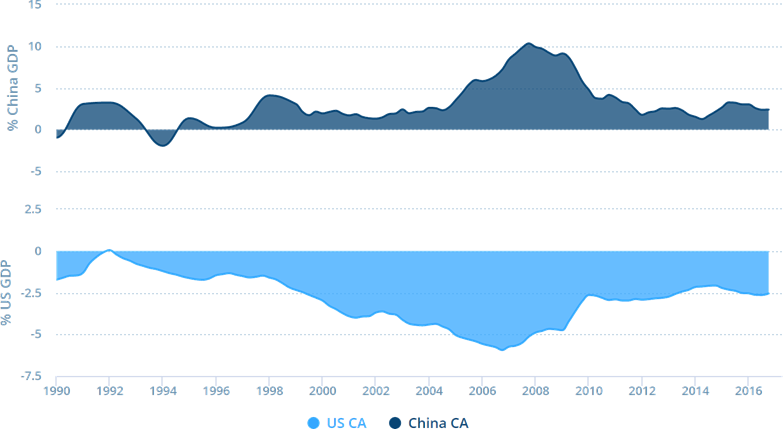
Figure 17. China's current-account surplus stands in sharp contrast to the US deficit.
By 2005, the US had reversed its stance, accusing China and its neighbors of hurting domestic manufacturers by refusing to let their currencies rise. To head off trade sanctions, China began allowing the yuan to strengthen, but only by a fraction of what was needed to restore global balance. Understandably, it had no wish to tamper with its economic success. China feared that abandoning its currency peg could trigger a dollar collapse, damage global growth, and wipe out the value of its own dollar reserves.
The Impossible Trinity
When it comes to the modern international monetary system, the Rolling Stones' line “You can't always get what you want” rings true. You want exchange-rate stability, capital mobility, and monetary independence, but you can only ever achieve two of the three at any one time. As we've seen, the gold standard and the euro combined capital mobility and currency stability, but sacrificed monetary independence. Bretton Woods, by contrast, paired stable exchange rates with central-bank autonomy, but imposed capital controls so strict that some travelers resorted to smuggling cash. The Washington Consensus, meanwhile, has been marked by free capital flows and monetary-policy autonomy, but exchange-rate instability.
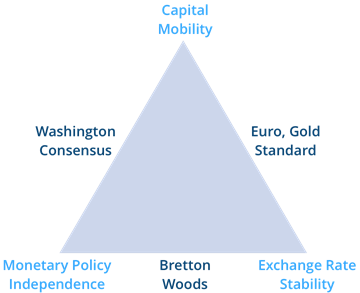
Figure 18. The impossible trinity, or currency trilemma.
Even taking the trilemma above into account, the current state of the international monetary system leaves a great deal to be desired. Chronic imbalances and the potential for a long-term dollar devaluation are creating considerable anxiety among policymakers. Even so, a major redesign along the lines of Bretton Woods is unlikely to be inevitable. The world has too much invested in the current monetary status quo, and there's no clear consensus on what might replace the existing system. Historically, it has taken a major upheaval, such as a world war or the threat of imminent national bankruptcy, to force a transition, and it's not clear whether the recent financial crisis amounted to a sufficient shock. Still, as we witnessed during Bretton Woods' twilight years, there comes a point where nations take matters into their own hands – where their self-interest in not rocking the boat is outweighed by their desire to escape a sinking ship. Gulf Arab states have debated returning to a gold-based currency in recent years, and it may be significant that the central banks of Russia and China have been steadily stockpiling gold. And where governments fear to tread, private citizens are busy building their own monetary system, courtesy of bitcoin.