The Fed has boxed itself in
After years of printing money and then trying to "tame" inflation by tightening liquidity, the U.S. Federal Reserve (the Fed) now finds itself officially at a crossroads.
Fed Chair Jerome Powell has confirmed that quantitative tightening (QT) is coming to an end — not because they hit their target, but because they simply can't keep going without the system starting to fall apart.
In other words, the Fed is reopening the door to money printing (QE) — a process markets love, but one that erodes the dollar's value and fuels inflation over the long run.
How we got here
To understand what's happening, you need to know how the financial "plumbing" the Fed manages actually works.
It's a system through which money constantly flows between banks, financial institutions, and the central bank — via instruments that control liquidity.
In the past, banks were required to keep a portion of their money at the Fed (so-called required reserves).
But in 2020 the Fed scrapped that requirement and started paying banks interest on the money they park there.
The result? It became more profitable for banks to leave money parked at the Fed than to lend it out to the economy.
Repo and Reverse Repo
The Fed uses two main mechanisms to manage liquidity:
Repo operations — the Fed lends money to the market, in other words injects liquidity.
Reverse repo operations — the Fed pulls money out of the system, in other words drains liquidity.
It's as if the Fed has a valve it can open or close as needed to let "monetary fluid" in or out, keeping the system stable.
The problem is that after the 2020 pandemic, these valves started behaving like a broken heating system — running at full blast non-stop.
What happened after 2020
To prevent a market collapse during the pandemic, the Fed launched quantitative easing (QE) — massive money printing and government bond buying.
That created a huge surplus of liquidity.
By the end of 2021, the reverse repo facility had swelled to over $2.5 trillion — a clear sign that there was too much money sloshing around in the system.
That was the moment the Fed should have stopped pumping money.
But it didn't.
Instead, it kept buying bonds and pushed its balance sheet even higher.
By the time it finally decided to stop QE and start QT (selling assets and draining liquidity), the water was already up to its neck.
Now that the drainage pipes are open, the system has started draining faster than expected.
A system running on empty
As the chart below shows, total reserves held by banks at the Federal Reserve began falling back in mid-2022 and are now at their lowest levels since the start of the QT cycle.
That means there's less and less "spare cash" left in the financial system to absorb shocks.
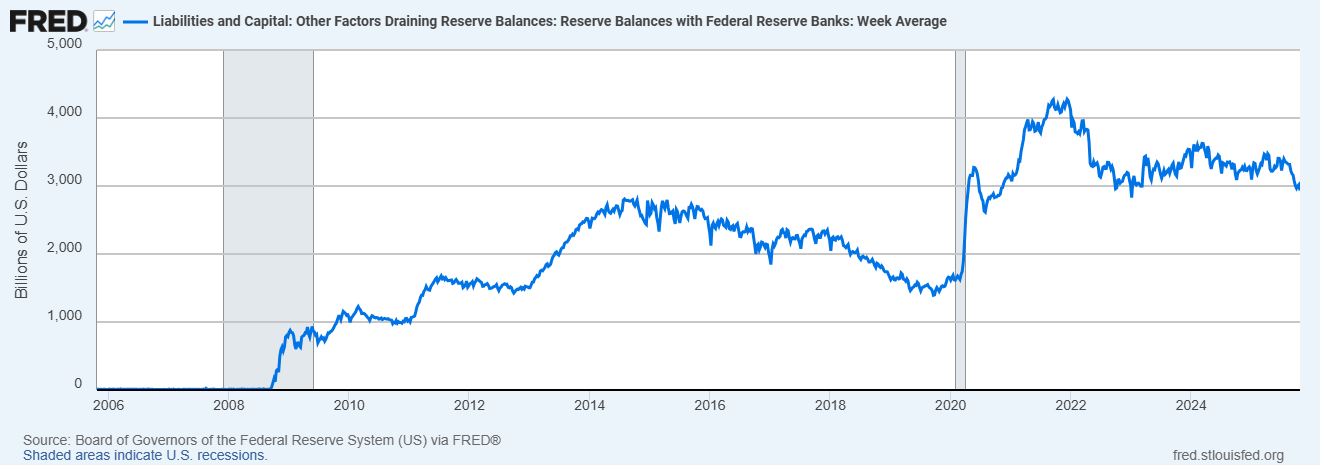
Banks no longer have surplus cash to park at the Fed, and short-term money markets are getting tighter by the day. The next chart shows how the reverse repo facility — which once held over $2.5 trillion in surplus liquidity — is now almost completely drained.
That means the system's "buffer zone" has deflated, leaving the money market without a safety net.
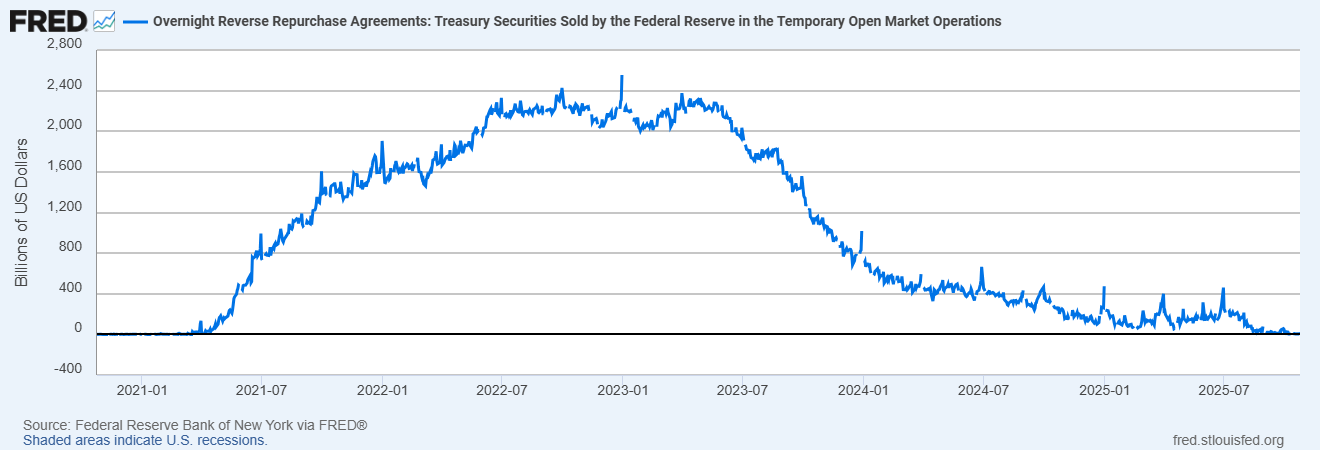 That's why the Fed has started injecting liquidity again through repo operations, trying to keep the system alive.
But those amounts — a few billion a day — are just a band-aid on a wound in a system worth well over a trillion dollars.
Powell's choice: inflation or collapse
Powell and the Fed are facing a simple but uncomfortable choice:
keep going with QT and risk a market collapse,
or start printing money again and risk a fresh wave of inflation. The Fed's total balance sheet (chart below) clearly shows the end of the expansion phase and the start of the QT that began in 2022.
But since the decline in the balance sheet is now slowing, it's clear the Fed can no longer keep up the same pace without destabilizing markets.
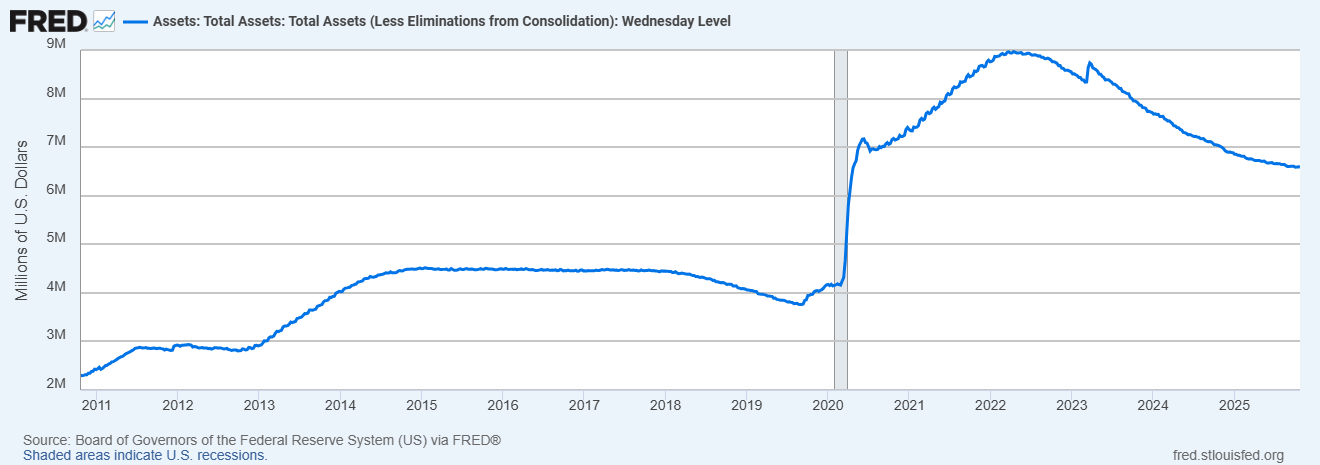
They've already decided — QT is ending, the printer is turning back on.
Powell said as much publicly: QT will end soon, and maturing securities on the Fed's balance sheet will be replaced with new ones.
In other words, the Fed will stop "pulling money" out of the system and start pumping liquidity back in.
The paradox of Fed policy
Ironically, the Fed will now likely have to do two opposite things at once:
print money to prevent a liquidity shortfall,
while keeping interest rates high so banks keep parking their money at the Fed.
That's the monetary paradox: hitting the brakes and the gas at the same time.
The result?
Liquidity will return, but the real economy will suffer again — while the financial sector earns interest on money that never actually reaches the economy.
What this means for markets
When liquidity returns, markets feel it first.
Stock, gold, crypto, and real estate prices rise, because excess money flows back into assets.
But that doesn't mean the economy is healthier — it just means the dollar's value is falling.
In other words, everything will be worth more in nominal terms, but that money will be worth less.
That's why seasoned investors (myself included) have been buying gold and other real assets for months now, knowing that sooner or later the Fed will have to print again.
A new cycle of illusion
Powell tried to pull off a so-called "soft landing" — cutting inflation without a recession.
That has never once happened in history.
Instead, the Fed is now opting for "no landing" — continued growth, but with persistent inflation and a loss of real purchasing power.
Markets will look "bullish" in the short term,
but in the long run — the value of money and savings keeps melting away.
A system with no way out
The Fed finds itself in a structural paradox:
if it tightens — markets break,
if it eases — inflation rises.
In the short term, we'll likely see rising asset prices and a loss of the dollar's purchasing power, but over the long run,
this is just another cycle of money printing that buys time, not a real solution.
The truth is that we all lose under this kind of policy. The money we use every day loses purchasing power, but by understanding what's happening right now, you can cushion the negative effects of central banks' mistakes.