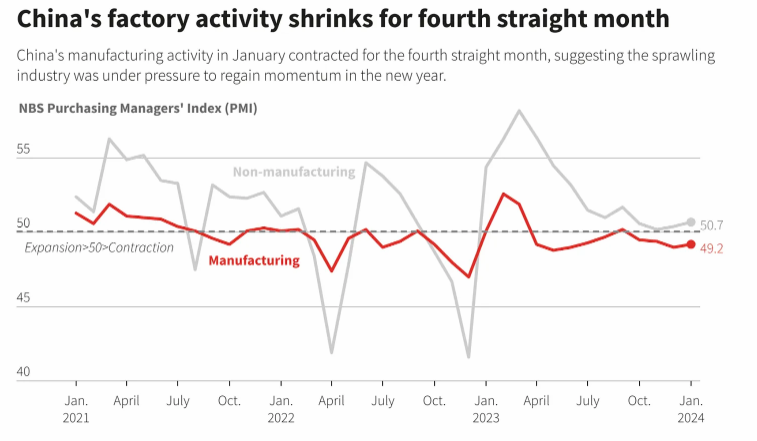
China is on the brink of recession. Aside from the Covid period, for the first time since 2008 — new data shows the economy of one of the world's manufacturing powerhouses has contracted for a fourth straight month, with particular weakness in new orders.
In other words, what they have left now is a backlog of orders still being worked through, and a downturn follows after that.
Manufacturing makes up a third of China's economy — far more than in the U.S. The collapse of China's real estate market — which makes up another third of the economy — is only pouring more fuel on the fire.
Offices emptier than during Covid
Office buildings in China are emptier now than they were during the Covid lockdowns. Remote work never really took hold in China, which suggests the main cause of empty offices is layoffs.
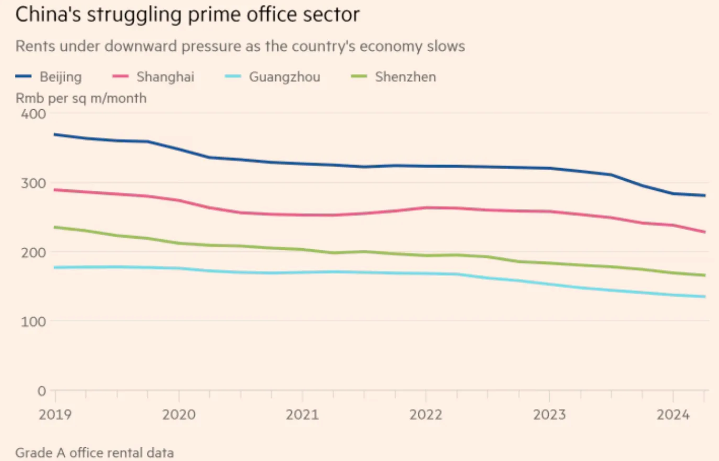
In Shanghai, offices sit 21% empty, while in Shenzhen, China's main export hub, vacancy stands at 27%. Those figures are far worse than during the lockdowns.
For reference, rents in Shenzhen have collapsed by 15% compared to the previous year.
Of course, official Chinese GDP figures seem immune to all of these troubles — but nobody believes them, not even people inside China.
Interestingly, not all the layoffs are tied to domestic companies: foreign investment into China has dropped by a third over the past year, as President Xi's authoritarianism pushes foreign firms away.
They're abandoning their offices in China and shifting operations to safer countries like Vietnam or Mexico, taking their factories with them.
A crisis among the young
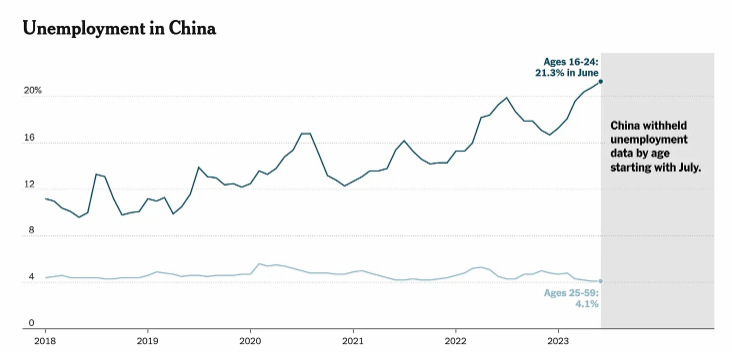
The downturn is hitting young Chinese the hardest, with youth unemployment jumping to nearly one in four.
With a record 12 million Chinese students set to graduate soon and enter the job market, they're not going to like what they find.
Naturally, all of this is social gunpowder. We're now seeing public protests in China, with banners on overpasses demanding free elections, and former soldiers accusing the government of "silencing" members of the military.
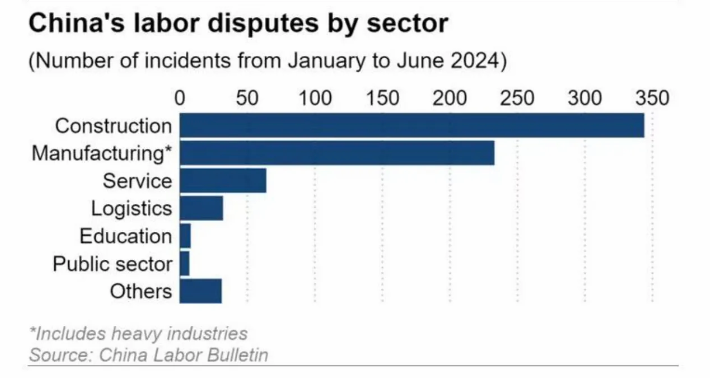
The number of worker strikes has also risen, including a thousand workers at a Nike factory who, ironically, revolted after production was moved to Indonesia. They're joined by hundreds of strikes by unpaid construction workers, as construction firms collapse.
Behind all this is the fact that hundreds of millions of Chinese work informally — a kind of internal residency permit is required to relocate to bigger cities where wages are decent, and most rural Chinese don't have one.
On top of that, 15 years of formal employment are required to qualify for a state pension. That means that for older workers — especially those without children due to the state's birth control policies — layoffs could literally mean starvation in old age. That's what makes Chinese workers desperate.
A conservative perspective — and facts the mainstream media won't cover.
What went wrong?
Growth under President Xi has fallen to half its former rate — China is now growing like an ordinary middle-income country.
That's because Xi, who idolizes Mao, launched a crackdown on business leaders — he even "erased" prominent entrepreneurs like Jack Ma of Alibaba from the map once they crossed him.
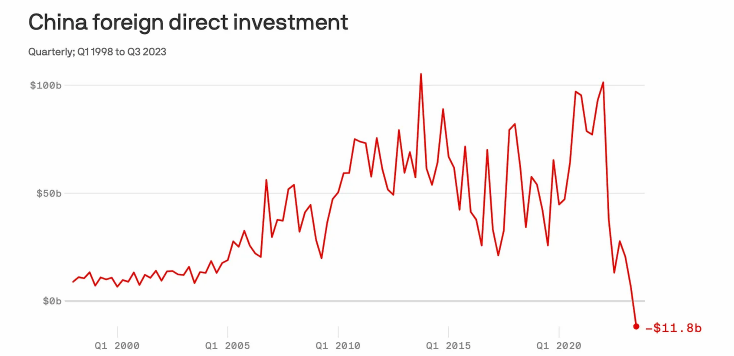
Meanwhile, Xi has poured trillions into industries favored by the state — chiefly green energy and housing construction. Both have now collapsed under oversupply and weak demand.
For example, China at one point had nearly 1,500 electric vehicle manufacturers. Almost all of them have gone under or are on their way there.
Meanwhile, the real estate sector is sitting on at least $5.5 trillion in bad loans, with millions of Chinese having lost the homes under construction that they poured their life savings into, as developers go bust.
Between the real estate collapse and a stock market that has been stagnant since 2008, ordinary Chinese simply don't have the money to keep spending, dragging the economy down even further.
What comes next?
The last time China entered a recession, back in 2008, Beijing poured massive stimulus into the economy. This time, China's debt — over $50 trillion — has grown to the point where it can no longer afford to do that.
And what if China falters?
China's social contract rests on obedience in exchange for growth. When the government fails to deliver growth, history shows the Chinese people become very active. There's a reason Xi is building a police state, but of course, if resistance becomes widespread enough, even the police can switch sides.
China could be headed for a turbulent period. And if it grows desperate and needs a nationalist distraction, it could drag Taiwan — and the U.S. along with it — into a storm.
The world is at a turning point. Democracies are shifting further right, while communist countries like China are seeing pushback against centralized rule.